Opening Golf to the World

Portmore Golf Park
Created in the 1990's on a family farm, Portmore Golf Park has been designed around water capture and reuse. All drainage water onsite is channeled through a series of storage lakes onsite, which feed the main irrigation system. In addition, water use in the clubhouse and functions building is significantly reduced through a series of innovative water saving measures including closed loop wash down pads, and rainwater use for driving range ball washing.
Portmore Golf Park was built by Colin Webber and his father and uncle on the family farm. The course originally opened as a driving range (1993) and a Par 3 (1996), which then had a 18 full length hole course added in two stages, opening in 1999 and 2004. Colin took the decision early on in the construction that it was much more advantageous in the long term to secure an onsite water supply, rather than install a comprehensive irrigation system. Thus, a series of lakes have been constructed over the years to harvest water from the site, which can then be used as irrigation water.
This was started in 1996 when Lake 1 (see map) was dug at the wettest part of the site. This lake naturally fills up from ground and surface drainage, as well as all Par 3 greens and tees drainage. Material from this lake was then used to build greens and tees for the Par 3.
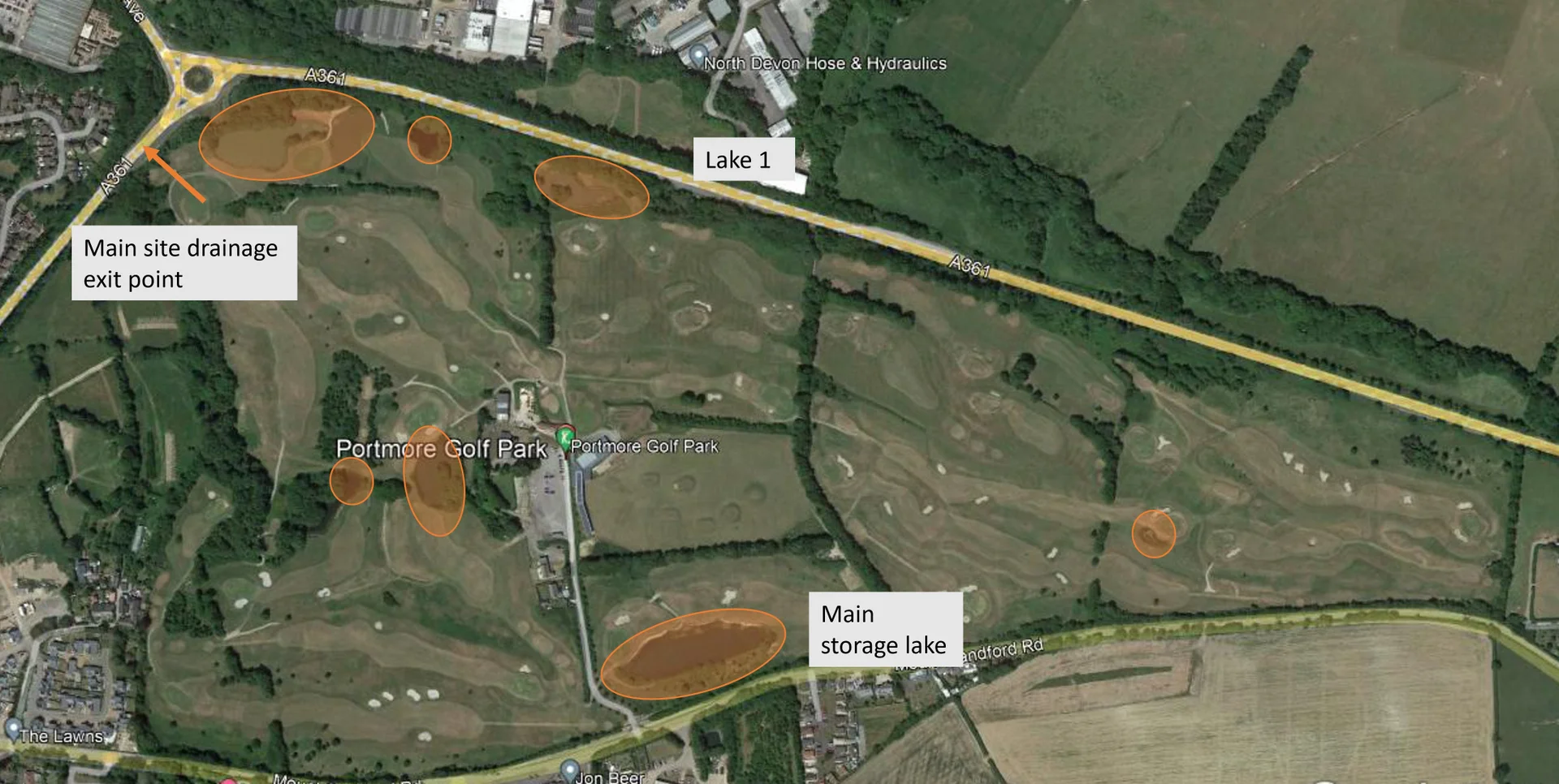
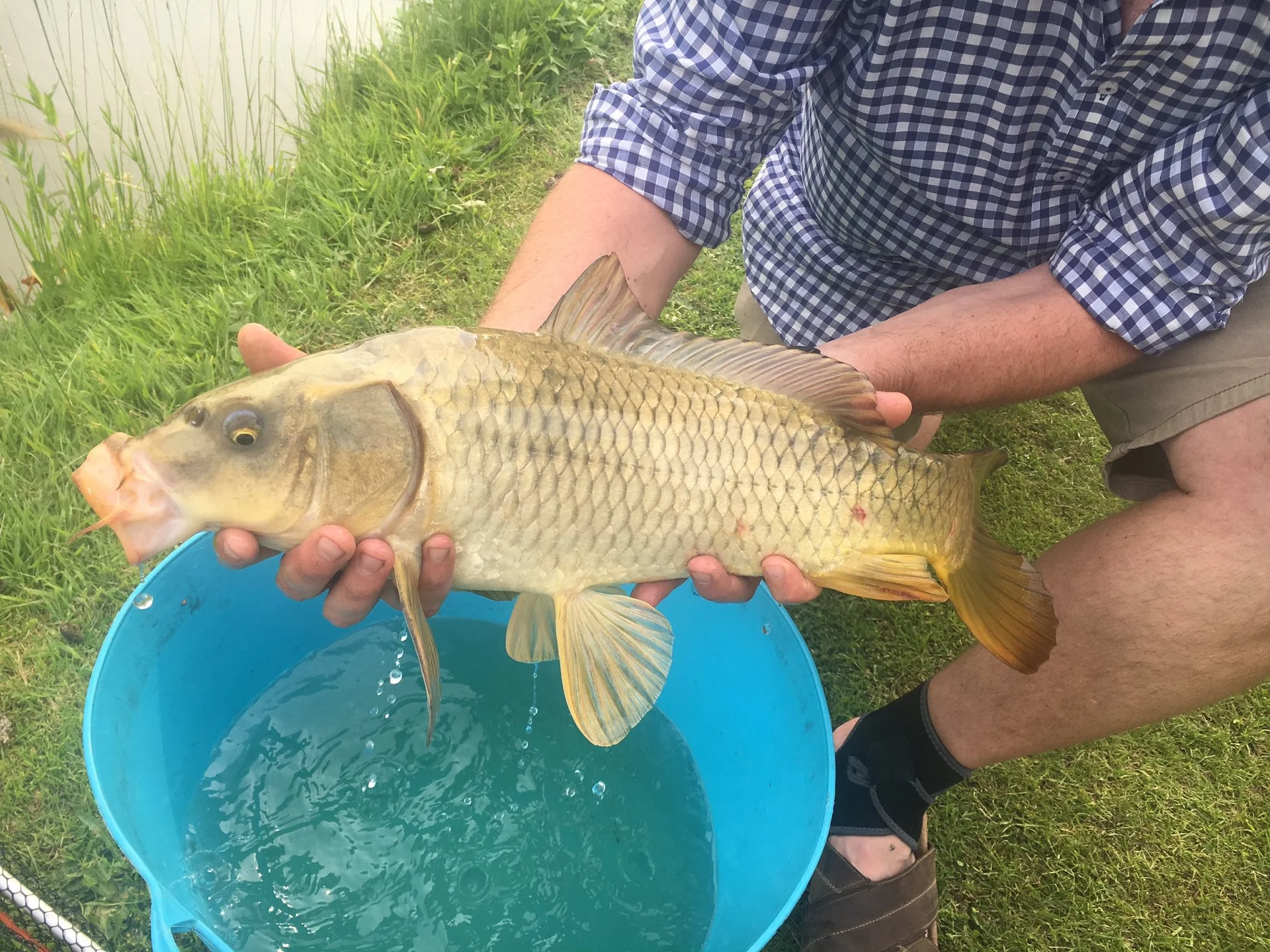
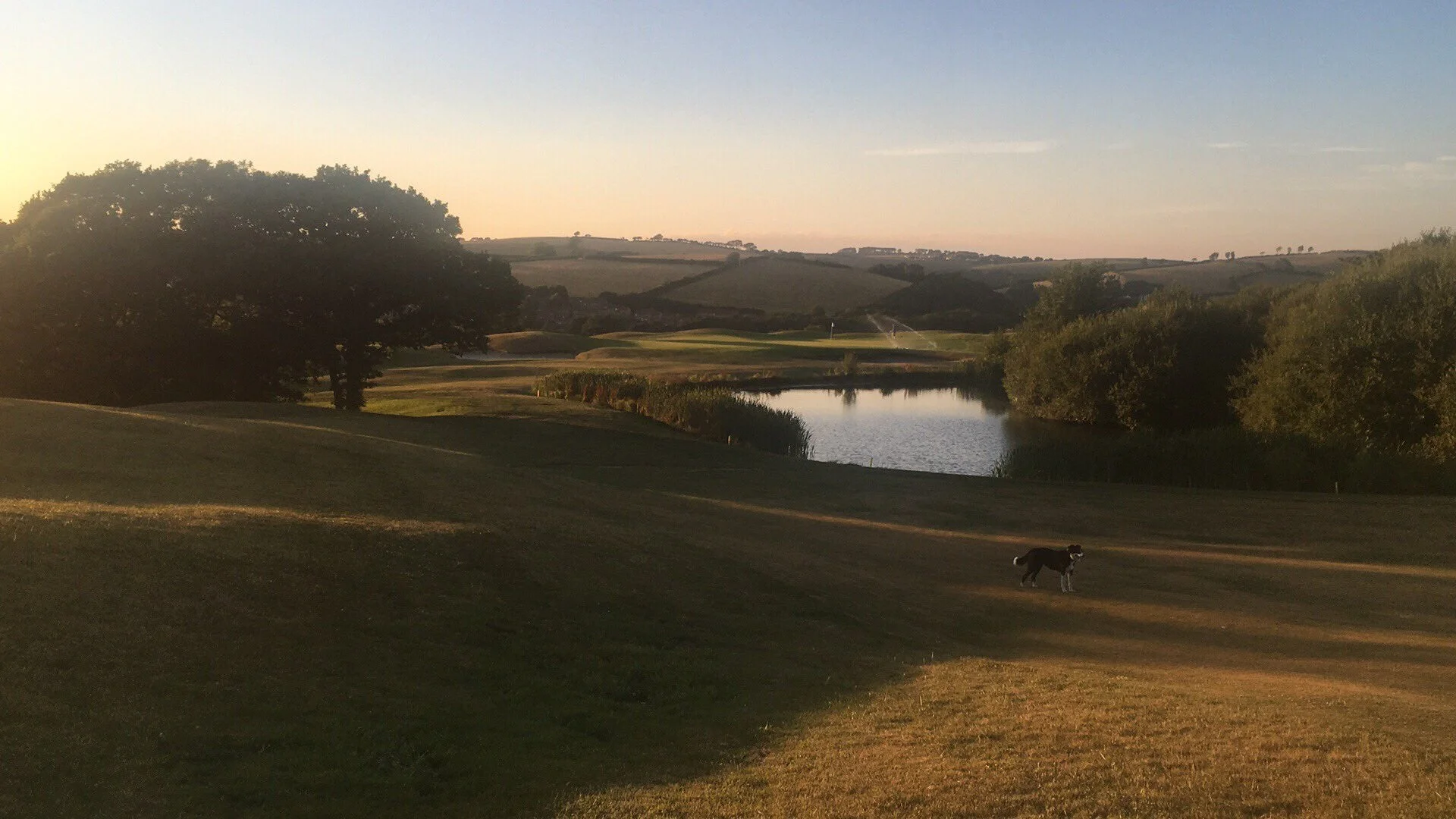
As the course developed, additional lakes have been dug which feed into the whole system. There is now a series of 11 lakes across the site. In particular the main lake (2-3000 m3) on the south edge of the course receives water from Landkey Road. This is then cleaned by the lake system, before being used as irrigation water. Ultimately the lake system drains to the West of the site into a stream which then runs into the River Taw. The lakes have been stocked with a variety of fish and boast a wide diversity of natural lake flora and fauna. This helps to add aesthetic value to the course, as well as naturally cleaning water as it moves through the site and acts as visual aid to assess the quality of the water.
The whole site has a main 63 mm irrigation pipe which has five sperate spurs, each with its own pump, which covers the entire site. Numerous access boxes have then been posited at key locations which then allows hand watering to take place where needed. Long term the club may install automatic irrigation at key points, but this is still not seen as main priority. Manual watering is only instigated after sustained periods of drought and at night, with the club preferring to rely on good natural resilience and recovery helped by the current maintenance programme.
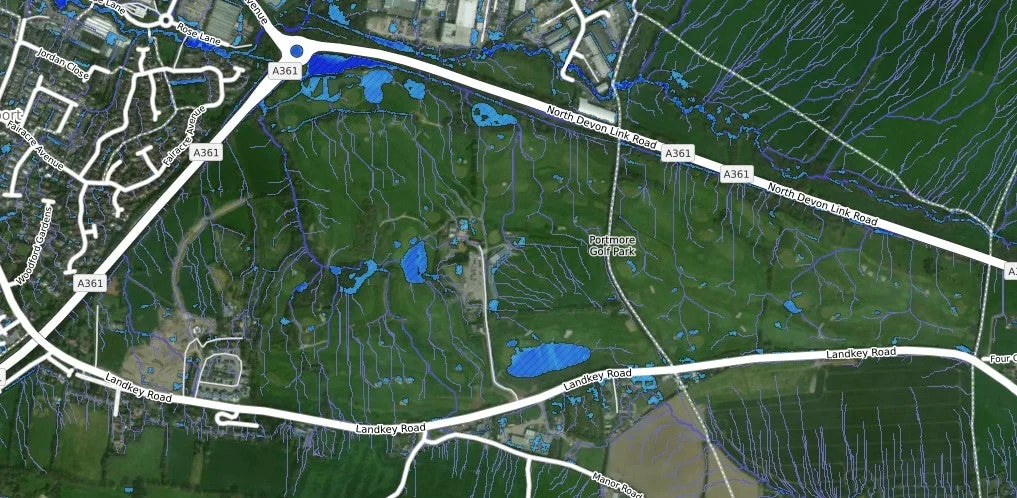
The map above shows how Colin and his team have utilsied the natural flow paths acorss the course to collect water in natural low spots for later reuse.
Greens are fescue dominated which allows a high level of natural resilience, whilst the club has a has a policy of minimally managed fairways, further reducing irrigation requirements. Colin estimates that the total cost of the lake system has been £250,000, with at least 50% of work completed inhouse. The system usually requires around £100 a day in fuel for pumps station operation, with this operated 3 days a week at most during dry spells.
Additional work completed around the site includes;
- Replaced old water main which was leaking which significantly helped to reduce overall site water bills.
- Harvesting rainwater off driving range roofs (550m2). This is used to flush all the driving toilets and wash all the range balls (at least 1-1.5m3 a day). The system involves redirecting guttering from the building into storage tanks built into the range building roof space. Any overflow from this is then redirected back into the lake system.
- A new wash pad for machinery was constructed for less than £2k. Water from the workshop roof is captured and then used to wash machinery down. This water drains into a natural grass filter bed constructed out of waste rootzone onsite. This ends up in a sump and is then repumped back to main wash pad storage tank for reuse. This water is also used for golfers troller and shoe wash down.
- Total cost = £250,000
- Number of lakes = 11
- Club is self sufficient for water apart from drinking water for clubhouse and kitchen use/washing. Annual water bill reduced from £6500 to £720 as a result of all these actions.